 Thomas Friedman is a three time Pullitzer Prize winning New York Times columnist and the author of National Bestseller The World Is Flat. When he takes a position on a major geopolitical issue people usually take notice. Just this week Mr. Friedman penned an article entitled "The Power of Green." Friedman's arguments are not all new, but he has an amazing knack for synthesizing ideas and giving them new energy. The backbone of this piece is something we are all vaguely aware of (thanks in no small part to Al Gore's An Inconvenient Truth): if the world doesn't start limiting its carbon emissions now, the CO2 levels in the atmosphere will double by midcentury and the earth's climate system will go "haywire."
The good news is America has more reasons than ever to start now.
- Geopolitical Reasons: Green = A Sustainable Future. We can reduce our carbon emissions all we want but the 3 billion people coming on to the world economic stage in Braizil, Russia, India and China (BRIC) need to housed, clothed and fed and currently carbon is the cheapest way to fuel that growth. The US grew "dirty" so we can't expect the BRIC countries to grow clean if it is costlier. We need renewable energy to reach the "China Price" (as cheap as coal) in order to ask the BRIC countries to grow clean. To do that we need to take the lead in developing and implementing the technologies to make it a reality.
- Patriotic Reasons: Green = Win the War on Terror. America's addiction to oil means we are financing both sides of the War on Terror: our tax dollars pay for our troops and our petrodollars enrich the Saudis and Iranians who in turn finance the export of fundamentalist Islam. That support tilts "the Islamic world in a more intolerant direction" and extends our War on Terror to younger generations. In other words using less foreign oil will quite literally dry up much of the funding for extreme fundamentalists.
- Capitalist Reasons: Green = Profits: There are huge economic incentives to being the world's leading supplier of renewable energy, and it feeds right in to our strength as a capitalist society. We can be the world economic leader on clean energy, and supply the "technologies that billions of others need to realize their own dreams without destroying the planet." Already Wal-Mart, GE and others are investing billions in clean energy solutions. But, the free market alone cannot sustain the kind of investment needed to create the solutions. We need our government to support the drive.
So what does this all mean. Well Mr. Friedman thinks it means that to be "green" no longer means being "liberal" or "tree-hugging", today being "green" is really all about being geostrategic, patriotic and capitalistic. Now that is a type of green that can appeal to the flag-waving American masses.
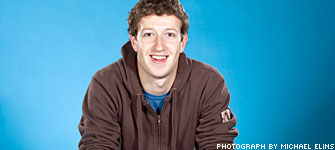 Mark Zuckerberg, the founder and CEO of Facebook.com, has found himself in the news yet again. This is nothing new for the 22 year old who took the Bill Gates route and dropped out of Harvard to build his empire. I have to give it to him, he turned a simple idea into a successful business more or less overnight. At one point in late 2006 the WSJ reported Yahoo had offered around $1 billion for Facebook. Many thought rejecting that offer was foolish, but I have a feeling Mark will get the last laugh. Just this week one of his venture backers said a $1 billion offer would be "way low."
The history of facebook as portrayed by Zuckerberg in bios written about him, and what really happened is still unclear. He claims that he developed the site because he felt there was a need for something like it on Harvard's campus. That part of it is indisputable. At the time a Harvard student lucky enough to live in Dunster House down on the river had no way to go online and look up a student living in Cabot House in the Quad. If this doesn't sound like a particularly bad thing, allow let me put together a more detailed thought experiment: if Mark Z. had met a cute sophomore who lived in another house there was no way for him to find her email address to follow up. Now you probably understand the utility of a site like facebook. The administration at the time was against providing such information to all students. So, the party line is that in comes Mark Z. with the idea of an online facebook with information that students fill out themselves. The end result is a company that could ultimately be valued at closer to $2 billion. Sounds pretty simple right?
The problem is, on September 2nd, 2004, seven months after Facebook launched, three Harvard students filed a legal suit against faceboook and its founders. These students, Divya Narendra (pictured), Cameron Winklevoss and Tyler Winklevoss claim that they hired Mark (albeit without pay) to help them build a social networking site called Harvard Connection. You can read all about the original suit on the Harvard Crimson website via this link. They allege that Mark wrote code for their site, but then turned around and used that code to set up thefacebook.com. The original suit was dropped because of a lack of evidence. However, the Winklevoss twins and Mr. Narendra haven't given up yet and most recently filed suit in Massachusetts on March 28th, 2007. I didn't see the actual documents but something tells me this second suit will seek damages well in excess of the $75,000 sought in the first suit back in 2004. Just where this case might lead is unknown, but one thing that is known is that Mark Z's story about the founding of Facebook may need to be re-written.
 Every now and then I come across a business venture that is as hilarious as it is ingenious. In this case the business is a website similar to YouTube which features short comedy video clips. Apparently a venture capital fund, Sequoia Capital, approached Creative Artists Agency about working with Will Ferrell and Adam McKay on the site. Sequoia of course is the venture fund that invested in YouTube, Google, Oracle, Yahoo and Apple; quite an enviable track record. Personally I have been a big Will Ferrell fan since he gave the Class Day speech during Commencement week at Harvard in 2003. I encourage you to check out that video here.
The first video Will and Adam came up with for the site is amazing. The site, www.FunnyorDie.com, has had nearly 2 million hits since its start a week ago fueled by the star power of Ferrell and McKay. I have embedded the first Will Ferrell video for your viewing pleasure. I apologize in advance for the vulgarity . . . the views expressed in the video by Will, Adam or Pearl (Adam's daughter) are not shared by this site.
UPDATE: I originally had the FunnyorDie.com video imbedded, but switched out that video for the YouTube version because FunnyorDie's video starts automatically, which is very annoying. However, YouTube took that video down because of copywrite claims by Funny or Die (see below). So if you want to find the video just go the FunnyorDie website by clicking here. I apologize for the confusion.

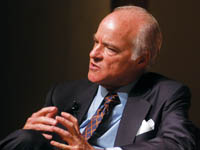 When Blackstone announced it was pursuing an IPO, the underwriting group included Morgan Stanley and Citigroup, with smaller roles by Merrill Lynch, Lehman Brothers, Credit Suisse and Deutsche Bank. Many in the industry considered Goldman Sachs' surprising absence from the group a major snub. The theory was that Blackstone and other PE shops were incensed over Goldman's major push into the PE world. Lloyd Blankfein, Goldman's CEO, has flatly denied these rumors insisting that his bank has great relationships with the other PE shops in spite of Goldman's huge new $20 billion buyout fund.
The truth of the matter however may be that there is another reason why Goldman isn't on the Blackstone deal, that reason is Henry Kravis, or perhaps Leon Black, depending on who you talk to. The New York Post reported that Goldman may be working with Kravis of Kravis Roberts & Co. on their IPO plans, or perhaps helping Leon Black of Apollo figure out if an IPO was in their future. Obviously with Goldman working with their competitors Blackstone decided to stay away. Mr. Blankfein makes a good point: "it's impossible for us to be in every piece of business." Of course more and more it seems that Goldman IS in every piece of business, but I digress . . .
So lets update our list of Private Equity Firms Going Public or at least considering it:
- Ripplewood Holdings: They took one of their funds public in Belgium.
- Goldman Sachs (GS): Okay, okay they aren't just a PE shop, but they do have one of the largest buyout funds, are publicly traded and have a forward PE ratio under 10. In my opinion GS is probably the safest/best play in the area.
- Fortress Investment Group (FIG): IPO'd in early February, has been very volatile.
- Blackstone Group: Closest private equity firm to an IPO. But should you invest?
- Carlyle Group: In "monitoring mode" for an IPO, whatever that means.
- Kravis Roberts & Co.: Probably just rumors . . .
- Apollo Management LP: Considering a partial sale to private investors.
- TPG Capital (formerly Texas Pacific Group): They aren't talking, but they are watching.
- Thomas H. Lee: Not considering a public offering because of lack of diversification.
- Permira: Firm's largest investor says younger management makes an IPO unlikely.
- Bain Capital: "Not actively looking at it, but we're always open-minded"
What does this all mean? With so much new money flowing in to buyout firms, with the universe of available deals shrinking and with the cost of debt rising, it doesn't seem like the boom in private equity can continue much longer. Each available deal is getting squeezed by competition and costs. Let us not forget that just this year a bidding war drove the cost of Equity Office Properties up by $3 billion!
But, with most of the top funds having billions to employ, the frenzy to snap up whatever deals remain will surely lead to an exciting 2007. I wouldn't be surprised if within the next year we see the
largest buyout in history.
 Fortress Investment Group (FIG) filed its first Annual Report this morning. As the first major hedge fund/private equity shop to go public the 10-K will be heavily scrutinized and for many it will be the first real peak inside an otherwise incredibly secretive part of our economy.
Needless to say, FIG has been enormously successful. They have grown their Assets Under Management (AUM) from $1.2 billion on December 31st, 2001 to $35.1 billion on December 31st, 2006. That is a 96.4% compound annual growth rate (CAGR). To handle the growth the firm employed 580 at the end of 2006, up from 400 the year before. With $1.52 billion of revenue that amounts to roughly $2.62 million of revenue per employee. For a comparison consider that Google produces $950K of revenue per employee and Wal-Mart manages just $183K. FIG's revenue mix consists of management fees and incentive income on its private equity funds, hedge funds and its publicly traded alternative investment vehicles which FIG calls "Castles." FIG also generates revenue from interest and dividends from its funds. Below is the PE/Hedge/Castle mix pulled straight off of the report:
 The risks inherent in this revenue mix should be obvious. First of all the incentive fees make up a full 60% of the 2006 numbers shown above. This revenue is not guaranteed and is linked entirely to FIG's skill in outperforming its benchmarks. In some sense that portion of FIG's revenue is not entirely unlike investing directly in a FIG fund. In fairness however, the numbers above are only a small part of the story. A full 73% of FIG's revenues are derived from "interest and dividend income" as seen below:
 The I&D income increased for a variety of reasons, but it too is linked the underlying performance of FIG's funds. Again the risk here is linked to FIG's underlying investment performance.
What are some other risks mentioned in the report?
- Key Man Risk: In other words it is the importance of FIG's human capital. If one of the key partners or MD's were to leave, provisions in the funds allow investors to withdraw capital. This is not even to mention the potential damage to returns.
- Competition: FIG hasn't been the only PE/Hedge firm to rapidly grow their AUM. There are only so many companies/strategies to invest in and it will be harder and harder to generate excess returns in such a competitive market.
- Litigation and Reputation Risk: When a firm consistently takes on new types of risk and is engaged in sophisticated investing techniques it is only a matter of time before one of their funds loses money. If litigation follows, perhaps combined with a general pock mark on FIG's sterling reputation assets may quickly leave the fold. Remember, most pension funds are at least somewhat sensitive to the reputation of their managers with whom they invest.
- Difficulty in Valuing Nonliquid Assets: FIG estimates that "as of December 31, 2006, $2.8 billion of investments in our private equity funds, $31.7 million of investments in our hybrid hedge funds and $256.4 million of investments in our liquid hedge funds are valued by internal models with significant unobservable market parameters." For those counting at home that is 10% of FIG's total AUM. If there is a change in the value of these assets this could materially change the performance of the company. In other words, because it has to "mark to market" its illiquid assets the firms numbers will always be estimates which may be revised.
Much of this information wasn't entirely new to the market, but certainly the most recent numbers were. The market seemed to have no problem digesting the 10-K as FIG was up 6% since market close on the 13th of April. This too after rising over 15% in the month leading up to the 13th. This puts the stock up roughly 70% or so from its IPO on February 8th. It is trading at a P/E in the low 40's. As many have predicted, the appetite of investors for exposure to this area of the market is substantial, no wonder
Blackstone and
Carlyle are both mulling over their options. It certainly seems that this party is not quite over yet.
 For those of you who just don't have it in you to pour over the proxies filed by the companies you invest in, I encourage you to visit footnoted.org. It is run by Michelle Leder and is considered by most pundits to be one of the top financial blogs on the web. Michelle somehow finds time in her busy schedule to mine through public records and find the little pieces of information that companies do their best to bury with fine print and ridiculous typeface. To make matters worse, (or better depending on how you look at it) heightened disclosure requirements of perquisites in recent years mean there is much more for Michelle to find.
For example just this morning Michelle discovered that Global Industries (GLBL) CEO William Dore "rang up $83K in expenses for 'an apartment provided to him by the company during his displacement as a result of Hurricane Rita.'" Now, this in and of itself probably doesn't jump out as being that uncommon given the kind of perks many CEO's are given even when they aren't displaced. The key here, as Michelle points out, is that "Hurricane Rita took place in 2005, not 2006." Just a minor oversight you could say . . . if I was an investor I might want to know exactly what happened to that $83K . . . .
If you run a hedge fund out of Greenwich Connecticut it is almost a requirement that you have a massive estate worth $20mm+. Most are on the water, but not all. Here are three. I could keep going for quite some time . . . .
Stevie Cohen, Founder of SAC Capital:

Eddie Lampert, Founder of ESL Investments:

Paul T. Jones, Founder Tudor Investment Corporation

 Yesterday the National Association of Realtors announced that 2007 will be the first home price decrease since the Great Depression. They revised down their estimate from a 1.9% increase to a 0.7% decrease in the national median price. The NAR is well known for putting out, how shall I say it, "optimistic" analysis. Downard revisions by industry organizations in and and of themselves are relatively common, but when the ever cheery NAR revises down, the actual number will in all likelihood be much, much worse. Some economists are calling for a 6%+ decline.
What we have here is the perfect storm:
- Tighter lending standards have eliminated 15-30% of prospective home buyers from the housing market.
- As we enter the first big wave of recasting mortgages many "motivated refinancers" will be unable to refinance and will quickly transition into "motivated sellers."
- In the conventional wisdom it is the motivated sellers that ultimately lead to price declines. A useful figure to track is the percentage of home sales per notice of default. In other words it is the percentage of sellers who are "motivated" by being unable to afford their own home. See the graph below for the San Diego area courtesy of Piggington (hint: this is not a good sign for the housing market):

Disclaimer
The content on this site is provided as general information only and should not be taken as investment advice. All site content, including advertisements, shall not be construed as a recommendation to buy or sell any security or financial instrument, or to participate in any particular trading or investment strategy. The ideas expressed on this site are solely the opinions of the author(s) who may or may not have a position in any company or advertiser referenced above. Any action that you take as a result of information, analysis, or advertisement on this site is ultimately your responsibility. Consult your investment adviser before making any investment decisions.


