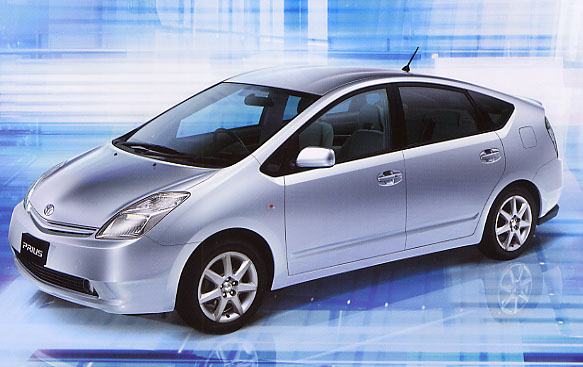
 If you are considering buying a hybrid you must first go check out TheIssue.com's analysis of the economics of buying a hybrid:
Hybrid cars are often considered the perfect match for the thrifty and environmentally conscience consumer. They save gas money, reduce pollutive emissions and ease demands on strained energy sources. While these benefits are almost certainly true, the cost-benefit equation is more complicated. Many would-be buyers find that the technology premium outweighs gas savings, and others point to environmental drawbacks like battery manufacturing.
Read on at
TheIssue.com.
Nervous investors have finally begun to step back and appraise the risks of the current market and have decided to take some profits off of the table. As of 3:00 EST all major indexes were off over 3% led by the S&P which was down 3.2%. Those dollars seems to have found a home in treasuries. Treasury prices rallied sending yields back under 4.8% for the first time since the middle of May. As many have predicted, renewed uncertainty about the direction of the market has helped the VIX volatility index reach a 13 month high at 21.95.
There are an abundance of scare factors in the current market. Just check out the list below. This is far from comprehensive but I feel it does highlight some of the main issues:
- Housing Market Slowdown- What started as a meltdown in the subprime market, has led to tightening credit, skyrocketing foreclosures, construction layoffs, the lowest building permit numbers in a decade, rising mortgage rates, contagion spreading to the alt-A and prime markets and the risk that the housing market weakness could extend well into 2009.

- Oil Prices - Prices have risen steadily this summer and topped $77 in trading this morning, before settling back down near $75. Even at $75 oil is up over 50% from earlier this year. We are certainly threatening the highs of last summer when crude trading into the $80's before falling in the winter.

- Consumer Spending - The housing slowdown and rising gasoline prices are starting to eat a hole in consumer's wallets. Retailers, grocers, automobile companies and hotels will be among the first to feel the squeeze. Just this week grocer Supervalue indicated that sales have slumped in the beginning of the third quarter. If consumers clamp up it will be virtually impossible to avoid a recessionary environment. Nouriel Roubini points out that recent data on weekly chain store retail sales suggest that the softness of retail sales in June is extending to July.
- High Yield Debt Market - A lower tolerance for risk among banks has led to rising yields, putting pressure on the financing of merger transactions. The credit squeeze makes private equity firms less likely to pursue major deals to keep the market rallying. Over the past two weeks Blackstone's $12 billion Chrysler financing and KKR's $10 billion Alliance Boots financing hit major snags and were postponed. Investors it seems just can't stomach any more risk in spite of low default rates. This does not bode well for the rest of the $400 billion of merger activity in the pipeline.

 The credit crunch isn't just effecting the major deals, in total over 32 deals have been postponed, sweetened or restructured in the past month. Meanwhile high yield credit spreads have risen 54% since the beginning of June.
- Corporate Capital Expenditure Weakness - Economists were surprised by a half point decline in durable goods orders in June. The feeling that after a dismal Q42006 and Q12007 capital expenditure would surely rebound in the second half of 2007 is beginning to look more and more like "wishful thinking." Businesses are likely looking at slow consumption growth and wondering why they should spend more money than they have to. In fact economists surveyed by the WSJ identified slow CapEx spending as the biggest threat to the US economy.

- Recession Odds: In review, the dismal first quarter GDP number of 0.7% even when combined with a strong second quarter of 3% (a guess) still only leave us with 1.8% in H1. If the risks above term out as I expect, growth in H2 should not improve much, if at all, on the 1.8% number. If there was a 12 month recession probability index, it would have gapped up this week.
Light sweet crude is approaching $76 a barrel after dipping as low as $55 earlier in the year. That's a 38% increase for those of you counting at home. We now look poised to explore the highs from last summer. The good news is the stock market seems to totally ignore crude oil prices these days . . .

Gas prices in San Diego are typically 20-40 cents above the national average. However, in the past 3 months prices in San Diego have converged upon the national price. The last time the prices converged was briefly in late 2005. If anyone has any explanation for why this has occurred I am all ears. Oh, and I do anticipate that prices have one more upward spike in them during late summer before retreating back under $3 in November/December.

 For the first time ever Toyota surpassed GM in quarterly world-wide sales. Most industry analysts have been calling for GM's dethroning for quite some time, so this is really no surprise. Unfortunately for Toyota being on top in vehicle sales is not an end unto itself. In the auto industry it isn't just quantity that counts, it is profitability. GM has always sold more cars than Toyota but they haven't been nearly as profitable in years.
I personally feel that the real growth story in cars over the next 5-10 years will be who can bring to market a compact, fuel efficient, ultra cheap car that can be sold to the burgeoning middle class in China and India. Who has the lead on that prototype? I'll give you a hint, it isn't Toyota and it isn't Hyundai. The leader is Tata Motors. The NYSE-listed (TTM), Indian auto maker announced plans for a car that retails for $2,500. And get this, their engineers have been trained in Toyota's manufacturing techniques! I agree it is an ambitious project but if Tata pulls it off they will be leaps and bounds ahead of GM and Toyota.
In retrospect however I think I may have missed out on one of the best paired trades ever. Check out the graph below assuming you had gone long TM and short GM 5 years ago today (click to enlarge):

 While we are talking about all things green I figured I would draw some attention to an article in the Economist about the IndyCar Racing League (IRL):
"This year's IndyCar Series, America's “open-wheel” version of Formula One Grand Prix racing, is not like any other. After the first two races of the season, held in Florida, drivers sniffed the air appreciatively. “It's kind of sweet. It's very organic and it's not really a harsh smell at all,” said Jeff Simmons, a driver with the Rahal Letterman team. What he was sniffing was ethanol. And as the large “E” signifies on the green flag that drops to start each race, all the whirling motors on the track are now propelled by corn-fuel."
It seems everything I read mentions Ethanol, biodiesel and other alternative fuels. Its a shame alternative fuels are still largely unavailable in gas stations. After all there are already 5 million flex fuel vehicles on the road today. If you look at the gas price map below you'll notice that California is getting hot (see chart below).

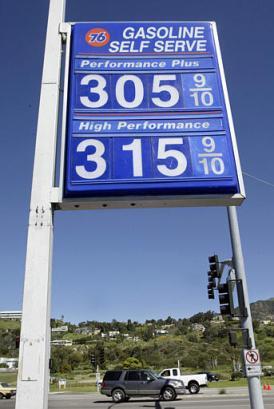 I filled up my gas tank a few days ago and noticed prices at the pump had jumped up significantly in the last few months. I remember filling up for $2.40/gallon as late as February 1st and thinking prices at the time were reasonable. Today the average price at the pump in San Diego is almost $3.15/gallon. And to think such a dramatic rise occurred with very limited media fanfare!
I'm sure most of you remember last summer when gas prices rose to over $3/gallon and the price of a barrel of crude oil rose to its peak of $79.86 and it was all we heard about 24 hours a day on the news (television, print, blogs, you name it). The price of a barrel of U.S. crude today is at $62.81 in after hours trading on the New York Mercantile Exchange. Prices have moved up from recent lows due to tensions with Iran. What would happen if Iraq destabilized, or Iran pursued nuclear weapons more aggressively or any number of other potentially inflammatory geopolitical events occurred in the Middle East? Well I'll give you a hint, if crude approaches $80/barrel again the American consumer (who last summer was still high on their home equity) will be hit particularly hard.
It is probably fairly apparent now why I have taken an interest in this. Not only because I don't like paying $60 to fill up my tank, but because I'm worried about a decrease in consumer spending and its effect on our economy.
So where do gas prices go from here? First, it is important for everyone to realize that gas prices do not move in lock step with oil prices even though oil is a huge factor in pricing. The cost of refining, marketing and federal and state taxes also effects gas pricing. For more information on the link, check out this page. But I ran a quick graph of gas prices at the pump for the past 4 years in San Diego, New York City and for the US average. There is some noise in the numbers but the trend is fairly clear. Gas prices at the pump usually bottom out every year during December and January and then rise in the Spring to hit their peak in late summer. In 2005 and 2006 the US average gas price peaked at $3/gallon. Could this be the year gas prices peak at $4/gallon?
Click on the chart to enlarge.

Some of you may be worried about the effects of gas prices on the economy, but imagine most just want to know how to save money at the pump. Well this site should give you some good ideas for saving on your own personal gas consumption. If you don't care about saving money but do care about the environment you can go to this site to purchase carbon offsets to reduce your personal carbon footprint. If you are looking for ways to hedge against a rise of gas prices through your investment account you can try to dabble in commodities (or through an oil etf like USO) though after expenses, trading costs and taxes it probably won't make sense. Though if you have access to a fuel bank, that might work. There, did we cover everyone?
Disclaimer
The content on this site is provided as general information only and should not be taken as investment advice. All site content, including advertisements, shall not be construed as a recommendation to buy or sell any security or financial instrument, or to participate in any particular trading or investment strategy. The ideas expressed on this site are solely the opinions of the author(s) who may or may not have a position in any company or advertiser referenced above. Any action that you take as a result of information, analysis, or advertisement on this site is ultimately your responsibility. Consult your investment adviser before making any investment decisions.


