Saturday, March 31, 2007

Eugene Fama on the Keys of Investing

Eugene Fama, the ultimate random walker, has a video on the Dimensional Fund Advisors website in which he gives advice to investors. I encourage you to view the video in its entirety here. Here is a quote of the most important advice:

"The evidence is quite clear. If you do any systematic analysis of investment performance what you find is people basically get return for risk and then from that you subtract fees and expenses. It is the costs that basically determine deferentials in portfolio performance. Active managers charge more so they tend to do worse. But, that doesn't mean people will stop doing it. Especially MBA students, all the ones that want to be portfolio managers want to be active managers naturally since if they're lucky and they win they end up rich. And that is very, very attractive to them so lots of students in my class even end up being active portfolio managers. I don't know where they learn how to do it though. The evidence is also clear that what does matter in portfolio strategies is asset allocation. The choice of stocks versus bonds and within stocks a tilt toward value and a tilt towards small. Now those are basically the decisions you face, plus international diversification is another aspect of it."
I agree with Eugene in large part, though I'm sure most Hedge Fund managers would watch this video and laugh all the way to the bank. I was a little bit disturbed by the fact that international diversification seems like such an afterthought to Gene as I feel it is such a pivotal part of portfolio construction. I also personally feel that utilizing other asset classes -- such as REITS and commodities -- can be very valuable in portfolio construction particularly as a means to dampen volatility and drive returns during prolonged market downturns. It would be interesting to ask Gene his opinion on that question in person. It might be a while before I get that opportunity . . .

Friday, March 30, 2007

Amaranth Trader Brian Hunter is Back

Earlier this morning I came across an article about the lawsuit that the San Diego Pension Fund filed against Amaranth a few days ago. One of the defendants in the lawsuit is Brian Hunter, the energy trader at Amaranth who managed to lose over $6 billions USD at Amaranth by placing big bets on the natural gas market. Hours later I stumbled across an article that blew my mind. Brian Hunter is raising capital to start a new hedge fund. The fund will be called Solengo Capital.

On top of starting a new fund, Mr. Hunter is building a beautiful new home in Calgary where Solengo will have an office.

I must say this guy has some guts, but I for one would never give him a single red cent. He may go on and on about the risk controls Solengo will have in place, but I believe he has hired Robert Jones to be his chief risk officer. Yes the same Robert Jones who was chief risk officer at Amaranth. Smart move Brian, we all know what a stellar job Bob did at Amaranth . . .

Wednesday, March 28, 2007

Commission Free Trading is Here

Back in 1970 if you decided to buy $2,000 worth of a stock through a broker the transaction may have cost you roughly $40. At first that may seem like no big deal, after all many people still pay roughly $40 to buy stocks through big wirehouse brokers. But $40 in 1970 is the equivalent of $215 today. Now, that's nothing to sneeze at.

For a long time brokerage firms depended on fixed trading costs as a consistent revenue stream. However in 1974 and 1975 Congress and the SEC took away the NYSE's ability to set the commission rates its member firms charged. Few large brokerage houses did anything at first, but eventually discount brokers like Charles Schwab emerged and offered lower commission trading for a fraction of the costs. These discount brokers pulled this off by not offering much in terms of research or guidance to its investors. That began the discount brokerage trading commission race to the bottom. Just a few years ago trading for $10 seemed like a great deal. Today, many investors are trading for absolutely free on sites like Zecco.com or through programs at large banks like Bank of America.

Many who follow the brokerage industry have long said that commission free trades are inevitable. But trading costs are not the only factor in where to hold your assets. The word on the street is that Zecco's interface has more ads than MySpace, still doesn't have a great trading platform and may be unreliable. Bank of America's free trading platform requires a $25,000 minimum investment. Unless you are a day trader the minimal costs savings probably don't outweigh the risks at this point. But, hopefully this move towards commission free trading will spread and discount brokers like Schwab and TD Ameritrade will follow. Until then, proceed with caution.

Monday, March 26, 2007

Where Do Gas Prices Go From Here?

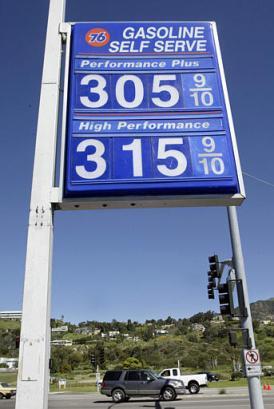
I filled up my gas tank a few days ago and noticed prices at the pump had jumped up significantly in the last few months. I remember filling up for $2.40/gallon as late as February 1st and thinking prices at the time were reasonable. Today the average price at the pump in San Diego is almost $3.15/gallon. And to think such a dramatic rise occurred with very limited media fanfare!

I'm sure most of you remember last summer when gas prices rose to over $3/gallon and the price of a barrel of crude oil rose to its peak of $79.86 and it was all we heard about 24 hours a day on the news (television, print, blogs, you name it). The price of a barrel of U.S. crude today is at $62.81 in after hours trading on the New York Mercantile Exchange. Prices have moved up from recent lows due to tensions with Iran. What would happen if Iraq destabilized, or Iran pursued nuclear weapons more aggressively or any number of other potentially inflammatory geopolitical events occurred in the Middle East? Well I'll give you a hint, if crude approaches $80/barrel again the American consumer (who last summer was still high on their home equity) will be hit particularly hard.

It is probably fairly apparent now why I have taken an interest in this. Not only because I don't like paying $60 to fill up my tank, but because I'm worried about a decrease in consumer spending and its effect on our economy.

So where do gas prices go from here? First, it is important for everyone to realize that gas prices do not move in lock step with oil prices even though oil is a huge factor in pricing. The cost of refining, marketing and federal and state taxes also effects gas pricing. For more information on the link, check out this page. But I ran a quick graph of gas prices at the pump for the past 4 years in San Diego, New York City and for the US average. There is some noise in the numbers but the trend is fairly clear. Gas prices at the pump usually bottom out every year during December and January and then rise in the Spring to hit their peak in late summer. In 2005 and 2006 the US average gas price peaked at $3/gallon. Could this be the year gas prices peak at $4/gallon?

Click on the chart to enlarge.


Some of you may be worried about the effects of gas prices on the economy, but imagine most just want to know how to save money at the pump. Well this site should give you some good ideas for saving on your own personal gas consumption. If you don't care about saving money but do care about the environment you can go to this site to purchase carbon offsets to reduce your personal carbon footprint. If you are looking for ways to hedge against a rise of gas prices through your investment account you can try to dabble in commodities (or through an oil etf like USO) though after expenses, trading costs and taxes it probably won't make sense. Though if you have access to a fuel bank, that might work. There, did we cover everyone?

Saturday, March 24, 2007

Jim Cramer on Market Manipulation

Interesting to hear from Jim how hedge fund managers manipulate the market. I think videos like this make random walkers like Burton Malkiel, Eugene Fama and John Bogle lose sleep at night. It's hard to argue that markets are completely efficient in the face of such obvious distortions by traders like Jim.

Come On Into the Water


Source: The Big Picture, Barry Ritholtz
Saturday Afternoon Funnies
http://bigpicture.typepad.com/comments/2007/03/friday_afternoo.html#more

Friday, March 23, 2007

New Century Clawing to Stave Off Bankruptcy

I have written a series of articles on New Century Financial. The first back on March 4th, another on March 8th and yet another on March 13th calling for New Century's bankruptcy. All of these articles relate to my feeling that subprime lending will not be sustainable in a declining real estate market. Well here is an update on the company's status. Today they successfully convinced Barclays Bank to not dump $900mm of loans back on the company. This was a marginally positive development for the company and by my sophisticated calculations the probability that New Century Financial (NEW) will avoid declaring Chapter 11 just went from 98% all the way down to 95%.

Clearly the outlook for this "New Shade of Blue Chip" is not good. New Century is in way over its head. The company is running precipitously low on cash and there are still roughly $7.1bb loans outstanding the banks could send back to New Century. The company is doing all it can to convince the banks that it is not in their best interest to force the company into bankruptcy, but the process is slow and isn't yielding much fruit. To make matters worse, the cash the company needs won't come from operations. Most of their funding sources have dried up and roughly a dozen states have demanded that the company cease operations, including New Century's home state of California. Even if they were to secure funding and operate in whatever states still allow them, they face a class action lawsuit from shareholders and the very real potential of additional legal action resulting from predatory lending allegations.

A few weeks ago Tom Brown of Second Curve had this to say about the subprime companies, including NEW and LEND which he had positions in:

"But I’ve been through this before. If history is any guide, the next few months are going to be a bumpy pain in the neck. But I continue to believe that the long-term reward will be substantial. This is the stock market. A bell doesn’t go off that tells investors when the risk has passed--and when the outlook does finally seem positive, the stocks will have already soared. But to me, the fundamentals are pretty clear, and bullish."
Well, Tom I hate to say this that bell you are waiting for may never go off. In my mind the fundamentals on New Century are pretty clear, and bearish.

Thursday, March 22, 2007

Harvard Dropout to Receive a Diploma

If I told you that a Harvard student dropped out 1975 after less than two years at the college, but was still awarded a diploma, albeit 32 years later, what would you say? What if I told you that this college dropout is also the richest man in the world? Well, Bill Gates never did graduate from Harvard, but he is going to be receiving his honorary Harvard diploma during the Commencement ceremonies this year. Apparently even a Harvard degree can be bought for the right price! Check out the announcement on the Harvard website here.

Its perhaps also worth noting that at last check the Bill and Melinda Gates Foundation Endowment is locked in a tight race with the Harvard Endowment for the title of the largest endowment in the world. The Gates Foundation is estimated to be worth close to $33bb while the Harvard Endowment was at $29.2bb as of June of 2006, though is probably over $30bb by now. However, with the addition of Warren Buffett's money, the Gates Foundation is expected to double in size and will most likely play a philanthropic role on this planet indefinitely. Never before in the history of mankind has such a high percentage of a country's wealth been earmarked for philanthropic purposes. Thanks Bill and Melinda (and Warren).

Big Ben Holds Rates, Market Throws Party

The FOMC did almost exactly what we expected, it held rates at 5-1/4 percent. The market however did something that I did not expect, it decided to celebrate. Check out the chart to the right see what I mean. Most major market indices were up over 1.5% on the day yesterday, so the rally left few behind. You can read the statement in its entirety here. I could break the press release down myself, or I could just point you towards the Wall Street Journal Online's analysis which I feel is very much on point. Please note how important each word is in the FRR. A slight modification of wording can actually move the markets. Read on below:


Source: The Wall Street Journal Online
http://online.wsj.com/public/resources/documents/info-fedparse0703.html

Tuesday, March 20, 2007

Are You a Member of the Pigou Club?

Late last year Greg Mankiw, a professor of Economics at Harvard University, wrote a Wall Street Journal article that he dubbed the "Pigou Club Manifesto." It is called the "Pigou Club Manifesto" after the late British economist Arthur Pigou(1877-1959). Pigou is perhaps best known for developing the concept of negative externalities. He felt that properly levied taxes on producers and consumers of products with negative externalities help align the incentives of interested parties with those of the negatively affected third parties. Mankiw's article argues for an increase in the tax on gasoline consumption. Imagine paying an extra $1.00 per gallon every time you go fill up your tank. Doesn't really make you too excited does it? Well I must admit upon first hearing this I was a little taken aback as well. But, after a quick review the policy seems to make good economic sense. Check out Professor Mankiw's article in its entirety here. The article is actually a quick read but I included a quick excerpt below to whet your appetite:

Campaign consultants aren't fond of this kind of proposal, but policy wonks keep pushing for it. Here's why:

The environment. The burning of gasoline emits several pollutants. These include carbon dioxide, a cause of global warming. Higher gasoline taxes, perhaps as part of a broader carbon tax, would be the most direct and least invasive policy to address environmental concerns.

Road congestion. Every time I am stuck in traffic, I wish my fellow motorists would drive less, perhaps by living closer to where they work or by taking public transport. A higher gas tax would give all of us the incentive to do just that, reducing congestion on streets and highways.
Please check out the rest over at Greg Mankiw's blog here.

Source: N. Gregory Mankiw
"The Pigou Club Manifesto" October 20th, 2006
http://gregmankiw.blogspot.com/2006/10/pigou-club-manifesto.html

Monday, March 19, 2007

Two Huge Mortgage Recast Waves

Credit Suisse put together a chart showing all adjustable rate mortgage recasts in the US. I think this chart clearly illustrates how much danger the real estate market is in. The first big wave on the chart is the result of subprime mortgages recasting/resetting. The subprime lending meltdown has thus far largely been with the subprime mortgage companies. Everyone has heard of the big public lenders like New Century and Accredited Home Loans but most people don't realize that roughly 41 lenders have gone out of business since late 2006. The ones that remain have tightened up their lending standards or stopped doing subprime loans entirely. The real casualties of this whole affair are the subprime borrowers. There are roughly $17.5bb of subprime recasts this month, but that number quickly doubles to $35bb in 8 months. It is going to be a slow, painful unraveling as all of these underwater (assuming home prices remain flat or negative) subprime borrowers realize that they can no longer get "no doc" subprime loans.

But, the subprime loans aren't the only problem, just the most immediate. Most of that fallout will occur in the next 2 years. The next big wave of recasting loans will be the option ARMS and Alt-A ARMS. We haven't even begun to talk about these loans yet because the worst will not hit for another 4 years. But, if you assume that the subprime fallout hits real estate prices fairly hard you have to figure that the default rate during the second wave could be even more deadly. Unless the real estate market miraculously turns around and starts to rise many of these borrowers will have to dig themselves out of a mortgage that may be anywhere from 5 to 20% larger than the FMV of their home. Remember this is what happened to homeowners in Japan that bought in during their 1980's real estate boom and subsequent bust. Some homeowners who bought homes in Tokyo 20 years ago are still underwater!! In fact the chart to the right shows that real estate prices in Japan have fallen for close to 17 straight years. I don't write this to scare people, but I do want to note that whenever there is a bubble someone gets stuck with the bill. In this case I have a feeling it won't be contained to just subprime lenders.

Source: Irvine Renter
Irvine Housing Blog
http://www.irvinehousingblog.com

Source: Wikipedia
Japanese Asset Price Bubble
http://en.wikipedia.org/wiki/Japanese_asset_price_bubble

Sunday, March 18, 2007

Merrill Lynch is Bearish on the Economy

I wrote a few weeks back about Alan Greenspan's recession prediction. Well it seems that Alan isn't the only one predicting a recession these days. Merrill Lynch issued a research report last week that came to the same conclusion. You can read the report here. They are urging Bernanke to cut interest rates this year to avert a recession.

The bottom line of all this is that it is becoming increasingly likely that a decline in home prices could lead to a recessionary environment. Therefore, following the leading housing indicators will be very important this year. As an investor facing these economic predictions remember that there is no replacement for a disciplined multiple asset class investment strategy. Don't let predictions scare you into changing your portfolio allocations. Not even Alan Greenspan and Merrill Lynch can see the future.

Friday, March 16, 2007

Blackstone Group Going Public?

Rumor has it that Blackstone Group plans to go public, selling a 10% stake of its management company in an IPO later this year. This would be a huge initial public offering and the founders, Stephen Schwarzman and Peter Peterson, could split upwards of $4 billion dollars. Not a bad payday for two guys who started the firm with $400K in 1985.

But why on earth would a private equity firm go public? Don't these guys thrive on taking public companies private? Don't they regularly lament the street's focus on quarterly earnings targets? Just this year Schwarzman, who may control upwards of 40% of Blackstone, had this to say about going public:

"I think the public markets are overrated," he told a panel at the annual Super Return private equity conference last month. When referring to the efforts of a rival that pursued an offering a year earlier, he added: "To divert yourself like that and then take on that cost is really not worth it."
So why do it, and why now? Well to start out, Blackstone isn't just a private equity firm. Of their $64bb under management, only $28bb is in private equity. The rest is hedge funds, debt funds, restructuring funds, real estate funds etc. They are by all means a diversified asset management company. And though this isn't a pure liquidity play you can imagine that Schwarzman, who is the 73rd richest American according to Forbes, is salivating over having a couple extra billion to invest.

This would also be the second large private asset management firm to go public this year following Fortress Investment Group, and it could be the beginning of a trend in the space. Keep in mind they are only selling 10% of the firm, they will still retain much of the control. The real danger is that though they are only giving up 10% of the equity they will be giving up 100% of their secrecy in the process. Stay tuned for more information on how the deal will be structured. It certainly will be interesting to get a peak inside a company known for its secrecy.

Thursday, March 15, 2007

Is Real Estate a Good Investment?

I've had a lot of people ask me whether or not residential real estate is a smart investment. Of course the question is usually couched liked this: "I only invest in real estate because it is the best investment, don't you agree?" Because I'd rather not ruffle too many feathers I usually just respond "it depends." The bottom line is that we just experienced a decade long real estate boom. No one wants to listen to anyone say that residential real estate should just be a home, not a retirement plan and certainly not the place to keep your entire nest egg. Three years from now I suspect this will be an easier conversation.

Instead of giving you my own long winded thesis on home ownership I will just refer you to a couple of charts and a great article from David Crook. Mr. Crook (great name eh?) is the Editor of the Wall Street Journal Weekend Edition and is the author of a great book entitled "The Wall Street Journal Complete Real-Estate Investing Guidebook." He's a smart guy, I just wish more people would listen to what he has to say. You can and should read the article in its entirety here. To whet your appetite check out this graph from the article.


I always say why present a case with words when you can accomplish much more with numbers. Well below you will find two graphs. Click each one to enlarge.

This first graph shows the annualized rate of return to stocks and real estate over 5 years from 2001-2006.

This second graph shows the annualized rate of return of stocks and real estate over thirty years from 1976-2006.
Remember, investing is about strategic asset allocation, rebalancing and time invested. The last time I checked most assets move in cycles. Over the past decade real estate has boomed, which tells me that real estate returns should revert to their longer term average over the next cycle. However since you live in your home it is hard to "rebalance" it as a part of your overall portfolio and perhaps even harder to make unemotional financial decisions about it. Therefore real estate should be a part of your investment strategy/retirement plan, but it probably shouldn't be your entire investment strategy/retirement plan. Remember diversification across asset classes works because we simply can't predict which asset class will outperform over the next 5-10 year period. If we knew that then we would sell all of our other investments and buy that one asset and hold it for 5-10 years.

I would love to hear comments or suggestions.

Wednesday, March 14, 2007

Countrywide's Mozilo is Selling Out

Starting with the Wall Street Journal a week ago much has been made of the fact that Angelo Mozilo, the Chairman and CEO of Countrywide Financial Corporation, has been engaging in a bit of doublespeak as of late. On the one hand he and CFO Eric Sieracki have been vigorous defenders of Countrywide's financial position. Mr. Sieracki called the company a "well-conditioned athlete" -- whatever that means. Mozilo appeared on CNBC this morning and said he felt it was unfair that investors were lumping "diversified financial services companies" like Countrywide and Wells Fargo (anyone else think comparing CFC with WFC is a bit of a stretch?) in with companies like New Century, NovaStar and Accredited Home Lenders. He described those companies as mono-line subprime lending companies. On the other hand, Mozilo has been exercising options and dumping Countrywide shares like they are going out of style. See the graph below courtesy of the SEC:


In Angelo's defense he has been systematically liquidating shares for quite some time. However, you can notice just from glancing at the chart above that the pace has quickened in recent months. By my calculations he has liquidated $69,918,490 worth of Countrywide shares since the beginning of December 2006.

Countrywide is one of the lenders that will most likely survive the subprime meltdown. Only 10% of their loan portfolio is technically "sub-prime." Though 15% of their loans over the past 2 years are considered Alt-A loans. There will probably be plenty of volatility ahead for Countrywide and while the company will survive it may not survive as an independent company. The stock is off 19% on the year and is trading at a P/E multiple of 8. There may be a sale sign out in front of their Calabasas Headquarters in the near future.

Now? Now? Not Yet.

This turned out to be a fairly good description of the market today . . .

Courtesy of Immobilienblasen.

Tuesday, March 13, 2007

New Century Delisted from NYSE

The NYSE decided today that New Century Financial's securities "are no longer suitable for continued listing on the NYSE." Check out the article here.

For those of you fortunate enough to have seen this coming you may be wondering whether it is time to start covering your short positions on subprime lenders. Check out this article over at the Motley Fool for some guidance. The tax code on this issue is fairly interesting.

For those of you still long (this may include Tom Brown), I wish you the best of luck. With any investing panic there are always companies that are dragged down too much and there are sure to be some interesting buying opportunities over the next year. If anyone has an example of a company that may present a good buying opportunity be sure to let me know.

Monday, March 12, 2007

Expect A New Century Bankruptcy Soon

I hate to say I told you so but it looks like New Century Mortgage is going under. Check out this article from Chris Isidore over at CNNMoney.com. Or, just read the highlights below:

The company's filings said that several of its lenders were now demanding New Century and its subsidiaries repurchase all outstanding mortgage loans, and that its other lenders now have the right to make that demand. It said if each of them do, its total repayment obligations would be about $8.4 billion.

"The company and its subsidiaries do not have sufficient liquidity to satisfy their outstanding repurchase obligations under the company's existing financing arrangements," said the company's filing.

"We know they didn't get their $8 billion by holding a bake sale. We knew it would touch other financial institutions; now we'll see how," said Art Hogan, chief market analyst at Jefferies & Co., about the impact New Century would have on the broader financial sector.

Officials at New Century could not be reached for further comment.

Bose George, analyst with Keefe, Bruyette & Woods, an investment bank focused on the financial services sector, said he saw little chance for New Century to avoid filing for bankruptcy unless it could find a buyer for its remaining assets. Even then he's not sure how much value there would be for the company's current shareholders, given its obligations.

In addition, he said that New Century's woes are certain to spread to other subprime lenders.

I agree with Bose, this won't be the last major subprime lender to face bankruptcy or sale this year. If you want to see a list of the 36 lenders and counting that have already gone under head over to The Mortgage Lender Implode-O-Meter.

Sunday, March 11, 2007

The Home ATM

Much has been made of the fact that US consumers have officially stopped saving money (see graph to the left). Believe it or not 2005 and 2006 were the first two years the US had a negative savings rate since 1932 and 1933. Needless to say, economic conditions in the 30's required US consumers to tap into savings in order to get by. But, today Americans are just addicted to spending. Consumer spending makes up 2/3 of our total GPD.


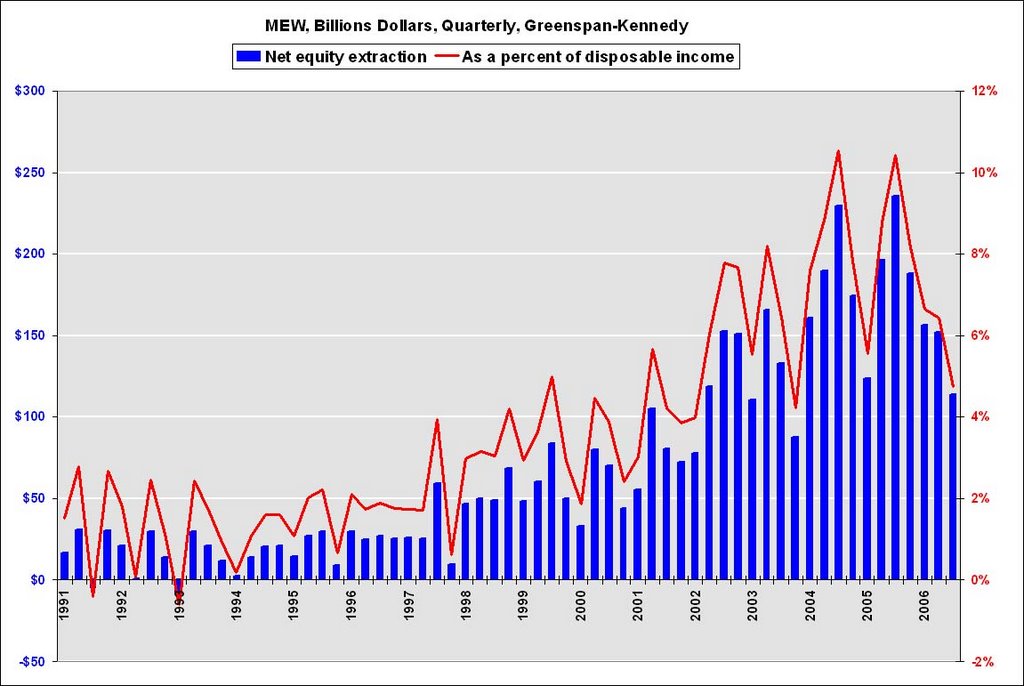
The American consumer has financed this spending binge by dipping into their home equity. Check out the graph to the left courtesy of CalculatedRisk. The amount of equity pulled out of residential real estate during the boom years is staggering. Many refer to this as Mortgage Equity Withdrawals or simply MEW.

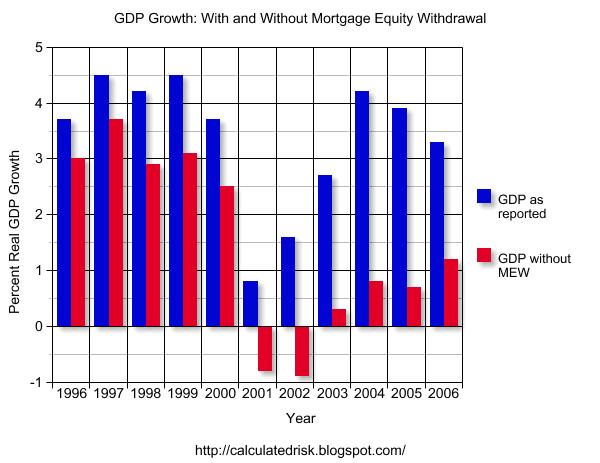
So what is going to happen when the real estate market stops rising so fast? The graph below may give us some indication.


This graph shows real GDP growth rates with and without MEW. US consumers for years have relied on their homes to support their spending habits. With more stringent lending standards and a fall in real estate prices on the horizon we should all expect that MEW and GDP will dip as a result.

Thursday, March 8, 2007

The Thomas K. Brown Affair

A few days ago I blogged about Thomas Brown's (not to be confused with Thomas Crown/Pierce Brosnan) Second Curve hedge funds. The funds placed big bets on a few of the subprime lenders and watched those positions deteriorate substantially over the past few weeks. Many of us in the blogosphere have been watching and waiting to see if Tom, who is an active blogger, would bring us up to speed on his current thinking. Well, he has obliged. Feel free to check out his post here. If you don't feel like reading the blog I can summarize it for you here: Tom is as bullish as ever.

Now I must admit that Tom's continued bullishness is admirable, however I do not agree with his thinking. Subprime lending is all well and good in a roaring bull market. However, on the eve of what looks to be a multi-year declining real estate market I think Tom might be a bit too early to the "Subprime Makes a Comeback" Party. From where I sit there is a perfect storm for the real estate market; home prices are falling, millions of families with adjustable mortgages face recast over the next 24 months, lending is tightening up considerably, there is a glut of inventory on the market, and a housing slowdown could slow the economy considerably (further imperiling the subprime borrower). Remember, real estate cycles are slow and painful. Subprime lending will come back, but it won't be overnight and it won't look like it does today.

Don't get me wrong, Tom makes some good points. He insists that "the stocks of the companies that survive will move up well ahead of any actual bullish news." Undoubtedly a handful of these companies will survive and recover. However, even if Tom does successfully pick the lenders that do survive I don't think the money that he will make back in subprime lending over the next 2-3 years will justify the loss he has surely taken over the last few months.

One of my favorite investing quotes comes from Peter Lynch. He said, "In this business if you're good you are right 6 times out of ten. You're never going to be right nine times out of ten." I don't wish any ill will upon Tom Brown but I hope it is his strong belief in a pending recovery and not his ego that has him holding on to companies like New Century Financial.

Sunday, March 4, 2007

The Subprime Lending Debacle

I have been monitoring the fallout in the subprime lending industry over the last few months closely. The most interesting story I have found relates to a hedge fund run by Thomas K. Brown called the Second Curve fund. For those of you who don't know Brown he is one of the "Tiger Cubs" that worked at Julian Robertson's Tiger Management hedge fund firm in the late 1990's. Tiger management had a great run throughout the 80's and 90's but closed its doors in 2000 after the firms total AUM went from $21 billion to $7 billion in just a few years. In spite of the losses Tiger Management spawned 4 or 5 successful hedge fund managers (hence "Tiger Cubs"), among whom Thomas Brown is one. He is considered by many to be a top expert on bank stocks. He also writes an interesting blog which you can read here.

I saw a headline late last week drawing attention to how poorly Brown's fund was performing this year. I did a little bit of research and noticed that in Brown's blog post on February 27th he speaks glowingly about the merits of several of the subprime lenders that have been absolutely punished by the market this week. Accredited Home Lenders Holding Co. is off 20% since the glowing review in Brown's blog and New Century Financial is down 67% since the post. Check out both stocks 1-year graphs below:

Accreddited Home Lenders Holding Co. (LEND)
(click for a larger view)

New Century Financial Corporation (REIT:NEW)
(click for a larger view)

Needless to say I think Brown must be having a devastating year. He was off 8.4% in January alone before this further punishment. I sure hope that Brown hedged some of his bets otherwise he may well have lost $100mm+ over the past 2 months. It will be interesting to see if Brown writes another blog post soon with comments on the correction. I've added his blog to my blogroll so you can access it directly from here. I'll let everyone know if he posts again soon.

Saturday, March 3, 2007

Two Weekend Birthdays

I consider it an honor to share my birthday this weekend with the S&P 500 Index. The index, which debuted on March 4th, 1957 has had quite an impressive run. Let's review a few interesting data points:

  1. S&P 500 Average Annual Return with Dividends Reinvested- 10.83%
  2. Roughly 1/3 of the average annual return is due to reinvested dividends.
  3. $1,000 Invested in the S&P 500 on 3/4/1957 is now worth over $170,000.
  4. $1.26 Trillion is invested in mutual funds and other investment vehicles that track the S&P 500 Index. That's roughly 9% of the value of all publicly traded stocks in the country.
  5. Only 86 of the original 500 companies in the index are still in the index today.
  6. If you had bought and held the 500 companies in the index on 3/4/1957 your average return would have been 11.71%. So buying and holding the original stocks dramatically outperformed buying and holding the index.
  7. Best one day percentage gain: October 21, 1987, +9.10%
  8. Worst one day percentage lost: October 19, 1987, -20.47%
  9. Average P/E 17.37 (Current P/E is 17.74)
  10. Mayor Michael Bloomberg has declared March 5th 2007 to be "S&P 500 Day." Don't forget to throw a party.
Have a great weekend.

Friday, March 2, 2007

Warren Buffett's Annual Shareholder Letter

There is much lore surrounding Buffett's annual shareholder letter. Many of the top investment managers in the country read the letter religiously. You too can read this years letter in its entirety here (warning it is 23 pages long).

This years letter was typical Buffett. He describes his company's successes in a self-effacing manner and throws in some of his characteristic folksy charm. He gives high praise to the managers who run his companies and insists it is them, not him, who truly drive results.

Buffett also highlights some of the major transitions Berkshire has gone through over the years. When Buffett began back in 1965 he and Charlie Munger invested the company's retained earnings and insurance float entirely in marketable securities. Over the years they have shifted to investing in operating companies. In so doing they have for many become a "buyer of choice." In other words business owners would rather sell to Berkshire than any other major buyer. Business owner and entrepreneurs prefer selling to Berkshire because of their successful history and tendency to leave companies in tact. The latter for many entrepreneurs may well be the most important factor.

After 40 years of operations however, Berkshire had never acquired an operating business outside of the US. In 2006 Berkshire did just that, acquiring ISCAR, an Isreali cutting tool business. Personally I feel that this is an important ideological shift for Berkshire and I'm certain it opens up the door to another period of impressive growth. Berkshire should look to increase its international holdings without lowering the quality of its acquisitions.

Later in the letter Buffet bemoans US spending habits and the transfer of assets overseas. He sees further dollar declines to come as the price to pay for our trade imbalances. Indeed he has put his money where his mouth is and his shareholders are profiting immensely from foreign currency transactions.

The most interesting part of the letter however was Buffett's acknowledgement that Berkshire doesn't actually have a long term replacement to run his investment division. He has developed a plan however:

I intend to hire a younger man or woman with the potential to manage a very large portfolio, who we hope will succeed me as Berkshire's chief investment officer when the need for someone to do that arises.

Anyone care to send in an application?

Thursday, March 1, 2007

Economics Revisited

For those of you who studied economics I think you will find this clip amusing.

Disclaimer

The content on this site is provided as general information only and should not be taken as investment advice. All site content, including advertisements, shall not be construed as a recommendation to buy or sell any security or financial instrument, or to participate in any particular trading or investment strategy. The ideas expressed on this site are solely the opinions of the author(s) who may or may not have a position in any company or advertiser referenced above. Any action that you take as a result of information, analysis, or advertisement on this site is ultimately your responsibility. Consult your investment adviser before making any investment decisions.