The NYSE decided today that New Century Financial's securities "are no longer suitable for continued listing on the NYSE." Check out the article here.
For those of you fortunate enough to have seen this coming you may be wondering whether it is time to start covering your short positions on subprime lenders. Check out this article over at the Motley Fool for some guidance. The tax code on this issue is fairly interesting.
For those of you still long (this may include Tom Brown), I wish you the best of luck. With any investing panic there are always companies that are dragged down too much and there are sure to be some interesting buying opportunities over the next year. If anyone has an example of a company that may present a good buying opportunity be sure to let me know.
I hate to say I told you so but it looks like New Century Mortgage is going under. Check out this article from Chris Isidore over at CNNMoney.com. Or, just read the highlights below:
The company's filings said that several of its lenders were now demanding New Century and its subsidiaries repurchase all outstanding mortgage loans, and that its other lenders now have the right to make that demand. It said if each of them do, its total repayment obligations would be about $8.4 billion.
"The company and its subsidiaries do not have sufficient liquidity to satisfy their outstanding repurchase obligations under the company's existing financing arrangements," said the company's filing.
"We know they didn't get their $8 billion by holding a bake sale. We knew it would touch other financial institutions; now we'll see how," said Art Hogan, chief market analyst at Jefferies & Co., about the impact New Century would have on the broader financial sector.
Officials at New Century could not be reached for further comment.
Bose George, analyst with Keefe, Bruyette & Woods, an investment bank focused on the financial services sector, said he saw little chance for New Century to avoid filing for bankruptcy unless it could find a buyer for its remaining assets. Even then he's not sure how much value there would be for the company's current shareholders, given its obligations.
In addition, he said that New Century's woes are certain to spread to other subprime lenders.
I agree with Bose, this won't be the last major subprime lender to face bankruptcy or sale this year. If you want to see a list of the 36 lenders and counting that have already gone under head over to The Mortgage Lender Implode-O-Meter.
Much has been made of the fact that US consumers have officially stopped saving money (see graph to the left). Believe it or not 2005 and 2006 were the first two years the US had a negative savings rate since 1932 and 1933. Needless to say, economic conditions in the 30's required US consumers to tap into savings in order to get by. But, today Americans are just addicted to spending. Consumer spending makes up 2/3 of our total GPD.
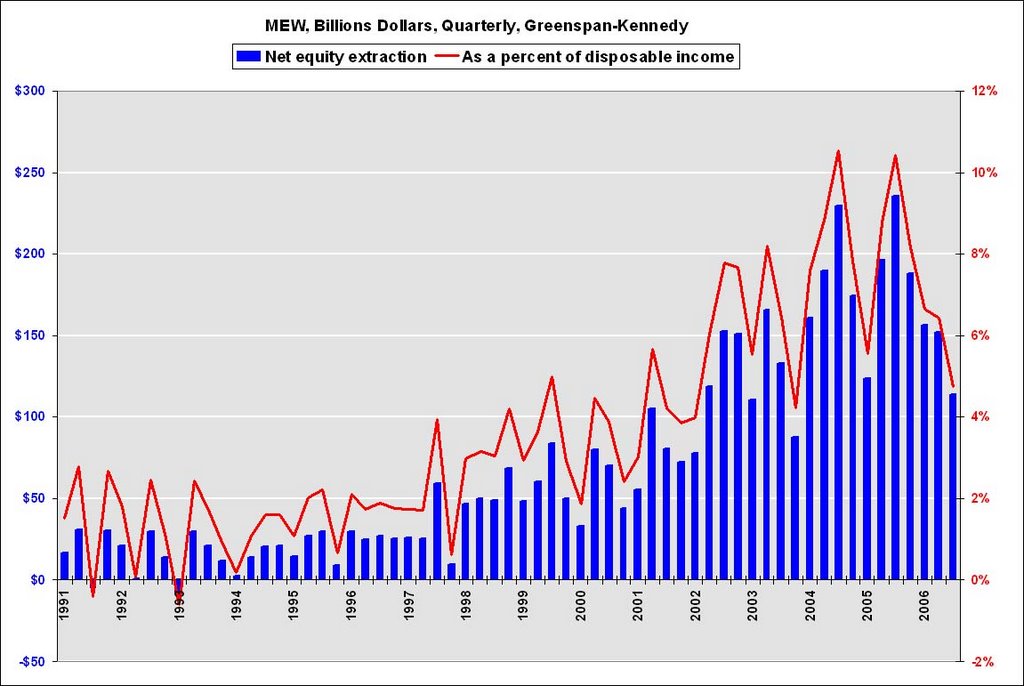
The American consumer has financed this spending binge by dipping into their home equity. Check out the graph to the left courtesy of CalculatedRisk. The amount of equity pulled out of residential real estate during the boom years is staggering. Many refer to this as Mortgage Equity Withdrawals or simply MEW.
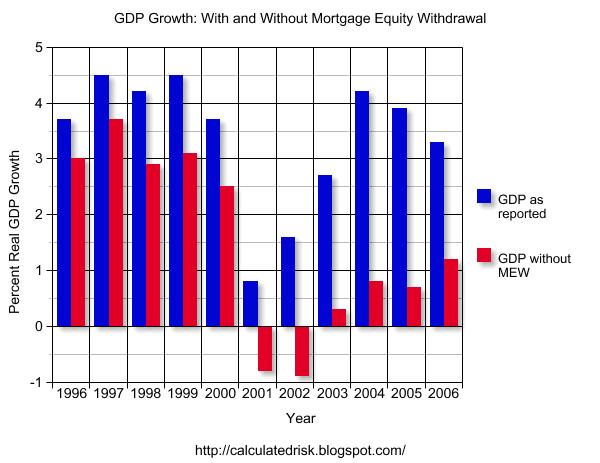
So what is going to happen when the real estate market stops rising so fast? The graph below may give us some indication.
This graph shows real GDP growth rates with and without MEW. US consumers for years have relied on their homes to support their spending habits. With more stringent lending standards and a fall in real estate prices on the horizon we should all expect that MEW and GDP will dip as a result.
A few days ago I blogged about Thomas Brown's (not to be confused with Thomas Crown/Pierce Brosnan) Second Curve hedge funds. The funds placed big bets on a few of the subprime lenders and watched those positions deteriorate substantially over the past few weeks. Many of us in the blogosphere have been watching and waiting to see if Tom, who is an active blogger, would bring us up to speed on his current thinking. Well, he has obliged. Feel free to check out his post here. If you don't feel like reading the blog I can summarize it for you here: Tom is as bullish as ever.
Now I must admit that Tom's continued bullishness is admirable, however I do not agree with his thinking. Subprime lending is all well and good in a roaring bull market. However, on the eve of what looks to be a multi-year declining real estate market I think Tom might be a bit too early to the "Subprime Makes a Comeback" Party. From where I sit there is a perfect storm for the real estate market; home prices are falling, millions of families with adjustable mortgages face recast over the next 24 months, lending is tightening up considerably, there is a glut of inventory on the market, and a housing slowdown could slow the economy considerably (further imperiling the subprime borrower). Remember, real estate cycles are slow and painful. Subprime lending will come back, but it won't be overnight and it won't look like it does today.
Don't get me wrong, Tom makes some good points. He insists that "the stocks of the companies that survive will move up well ahead of any actual bullish news." Undoubtedly a handful of these companies will survive and recover. However, even if Tom does successfully pick the lenders that do survive I don't think the money that he will make back in subprime lending over the next 2-3 years will justify the loss he has surely taken over the last few months.
One of my favorite investing quotes comes from Peter Lynch. He said, "In this business if you're good you are right 6 times out of ten. You're never going to be right nine times out of ten." I don't wish any ill will upon Tom Brown but I hope it is his strong belief in a pending recovery and not his ego that has him holding on to companies like New Century Financial.
I have been monitoring the fallout in the subprime lending industry over the last few months closely. The most interesting story I have found relates to a hedge fund run by Thomas K. Brown called the Second Curve fund. For those of you who don't know Brown he is one of the "Tiger Cubs" that worked at Julian Robertson's Tiger Management hedge fund firm in the late 1990's. Tiger management had a great run throughout the 80's and 90's but closed its doors in 2000 after the firms total AUM went from $21 billion to $7 billion in just a few years. In spite of the losses Tiger Management spawned 4 or 5 successful hedge fund managers (hence "Tiger Cubs"), among whom Thomas Brown is one. He is considered by many to be a top expert on bank stocks. He also writes an interesting blog which you can read here.
I saw a headline late last week drawing attention to how poorly Brown's fund was performing this year. I did a little bit of research and noticed that in Brown's blog post on February 27th he speaks glowingly about the merits of several of the subprime lenders that have been absolutely punished by the market this week. Accredited Home Lenders Holding Co. is off 20% since the glowing review in Brown's blog and New Century Financial is down 67% since the post. Check out both stocks 1-year graphs below:
Accreddited Home Lenders Holding Co. (LEND)
(click for a larger view)
New Century Financial Corporation (REIT:NEW)
(click for a larger view)
Needless to say I think Brown must be having a devastating year. He was off 8.4% in January alone before this further punishment. I sure hope that Brown hedged some of his bets otherwise he may well have lost $100mm+ over the past 2 months. It will be interesting to see if Brown writes another blog post soon with comments on the correction. I've added his blog to my blogroll so you can access it directly from here. I'll let everyone know if he posts again soon.
I consider it an honor to share my birthday this weekend with the S&P 500 Index. The index, which debuted on March 4th, 1957 has had quite an impressive run. Let's review a few interesting data points:
S&P 500 Average Annual Return with Dividends Reinvested- 10.83%
Roughly 1/3 of the average annual return is due to reinvested dividends.
$1,000 Invested in the S&P 500 on 3/4/1957 is now worth over $170,000.
$1.26 Trillion is invested in mutual funds and other investment vehicles that track the S&P 500 Index. That's roughly 9% of the value of all publicly traded stocks in the country.
Only 86 of the original 500 companies in the index are still in the index today.
If you had bought and held the 500 companies in the index on 3/4/1957 your average return would have been 11.71%. So buying and holding the original stocks dramatically outperformed buying and holding the index.
Best one day percentage gain: October 21, 1987, +9.10%
Worst one day percentage lost: October 19, 1987, -20.47%
Average P/E 17.37 (Current P/E is 17.74)
Mayor Michael Bloomberg has declared March 5th 2007 to be "S&P 500 Day." Don't forget to throw a party.
There is much lore surrounding Buffett's annual shareholder letter. Many of the top investment managers in the country read the letter religiously. You too can read this years letter in its entirety here (warning it is 23 pages long).
This years letter was typical Buffett. He describes his company's successes in a self-effacing manner and throws in some of his characteristic folksy charm. He gives high praise to the managers who run his companies and insists it is them, not him, who truly drive results.
Buffett also highlights some of the major transitions Berkshire has gone through over the years. When Buffett began back in 1965 he and Charlie Munger invested the company's retained earnings and insurance float entirely in marketable securities. Over the years they have shifted to investing in operating companies. In so doing they have for many become a "buyer of choice." In other words business owners would rather sell to Berkshire than any other major buyer. Business owner and entrepreneurs prefer selling to Berkshire because of their successful history and tendency to leave companies in tact. The latter for many entrepreneurs may well be the most important factor.
After 40 years of operations however, Berkshire had never acquired an operating business outside of the US. In 2006 Berkshire did just that, acquiring ISCAR, an Isreali cutting tool business. Personally I feel that this is an important ideological shift for Berkshire and I'm certain it opens up the door to another period of impressive growth. Berkshire should look to increase its international holdings without lowering the quality of its acquisitions.
Later in the letter Buffet bemoans US spending habits and the transfer of assets overseas. He sees further dollar declines to come as the price to pay for our trade imbalances. Indeed he has put his money where his mouth is and his shareholders are profiting immensely from foreign currency transactions.
The most interesting part of the letter however was Buffett's acknowledgement that Berkshire doesn't actually have a long term replacement to run his investment division. He has developed a plan however:
I intend to hire a younger man or woman with the potential to manage a very large portfolio, who we hope will succeed me as Berkshire's chief investment officer when the need for someone to do that arises.
The content on this site is provided as general information only and should not be taken as investment advice. All site content, including advertisements, shall not be construed as a recommendation to buy or sell any security or financial instrument, or to participate in any particular trading or investment strategy. The ideas expressed on this site are solely the opinions of the author(s) who may or may not have a position in any company or advertiser referenced above. Any action that you take as a result of information, analysis, or advertisement on this site is ultimately your responsibility. Consult your investment adviser before making any investment decisions.
 The NYSE decided today that New Century Financial's securities "are no longer suitable for continued listing on the NYSE." Check out the article here.